Sat Narayan
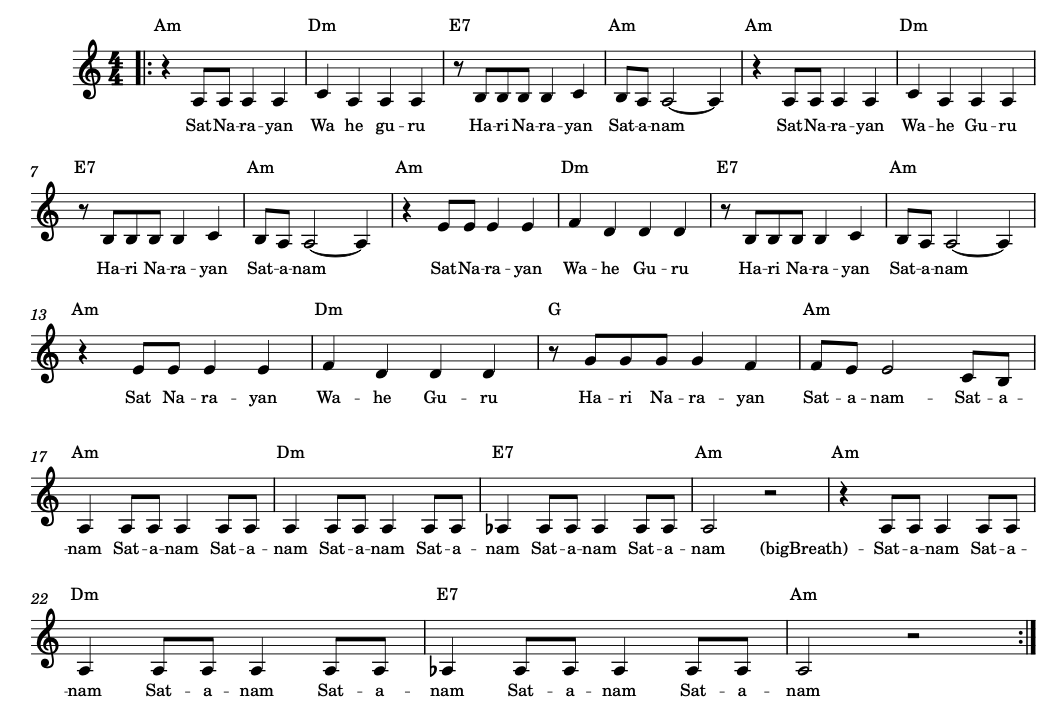
Note to guitars: The pattern is to repeat Am Dm E7 Am, except resolving to the G on the high part at end.
Sat Narayan Wahe Guru
Hari Narayan Sat Nam
2 times low, 2 times high
Chant: Sat Nam
Translation:
Sat Narayan is True Sustainer,
Wahe Guru is indescribable Wisdom,
Hari Narayan is creative sustenance
Sat Nam is True Identity.
Note: Satnam is pronounced sat-a-nam
This is a meditative movement to the left with left foot concentration. Holding hands:
First Part:
- Step left with left foot, join with right.
- Step in with left foot, join with right.
- Step left with left foot, join with right.
- Step out with left foot, join with right.
First step is on the beat before Sat Narayan
Chant:
On the “Sat Nam” chant simply step to the left.
Note the rest in the chant where it is notated (BigBreath). To help dancers find this rest I have them take a big breath, because big breaths are nice and it keeps them from singing the first few times through until they can hear where the rest comes in.
It’s okay to change the movements at some time. Going to the left for too long can be hard on the hips. At the leader’s discretion Go in and out, or walk to the right.
• More Information:
Narayan is the aspect of Infinity that relates to the water element. This dance helps you “go with the flow” and takes you beyond the thinking mind.
Take Me as I Am Zikr
by Connie Zareen Delaney

Special Chords:
Bm7 = xx5430 to xx5435 (add pinky) Esus = 020200
- La illa ha il Allah, La illa ha il Allah (There is no reality but the one true reality)
- La illa ha il Allah
- Estaferallah (Make me pure enough to see it)
Attunement:
This zikr uses the same chords as Take Me As I Am, a hymn from the Iona community that was put into a dance by Talia Marcus. It occurred to me, while leading that dance, that the zikr phrase “La illa ha il Allah” is like existence standing before us and asking us to stop creating concepts around how we think reality should be. Like the universe itself is asking us to “Take Me As I Am.”
Movements:
- Row, rocking in on right foot and back out on left foot (which is behind) twice, then sidestep for four beats on the final “lah.”
- Step back four steps, step in four steps.
- Turn to the left brushing dust from the heart.
Om Tare Liberation
Traditional Melody adapted by Connie Zareen Delaney

Om Tare Tuttare Ture Soha
Om Om Tare Om
Singing praise to the Bodhisattva of compassion in her manifestation as Green Tara
Movements:
Dancers are not holding hands. On the first phrase walk to the right, hands start at the heart and swoop gently upward and right three times, then on Soha hands go further right and up, looking up, then coming back to the heart. It’s a graceful movement.
On second phrase do the same movements to the left, then on the third do it again to the right.
On ‘Om Om Tare Om’ everyone faces center and takes four steps back, arms sweeping back in a bow. Then come four steps in, arms sweeping in and ending with a Namaste bow.
Attunement:
This dance is called Om Tare Liberation because the first Dalai Lama wrote that we can call on her to instantly save us from eight particular dangers, each of which represents a corresponding human mental problem:
Green Tara Mantra
The first Dalai Lama wrote that we can call on her to instantly save us from eight particular dangers, each of which represents a corresponding human mental problem:
Lions — pride
Wild elephants — delusion and ignorance
Forest fires — hatred
Snakes — jealousy
Robbers — wrong views, including fanatical views
Prisons — greed and miserliness
Floods — desire and attachment
Demons — doubts caused by delusion
Download PDFhttps://www.youtube.com/embed/eZi_g12C3uw
Eh Namowe
Connie Zareen Delaney

Attunement:
Eh Namo We In Arabic means “We are here.” Namo in Sanskrit is to bow.
The rhythm of this song floats through the melody in a haunting way. Even though all the phrases start solidly on the one beat, it feels like it’s moving. The dance movements are very simple to let dancers experience the movement of the melody, as we celebrate that we are all here.
Be sure to instruct any drummers not to try to drum the melody, but to stay solidly on the four beat (it’s surprisingly hard to do until the drummer really understands how the melody moves).
Movements:
- Start out with dancers close in, sidestepping gently to the right on the rhythm.
- After the song has progressed for a while, and the rhythm has sunk deeply in, add the movement of four steps out and four steps in on the Ehnamowe downbeat, right after the rising melody on “Oo-oh”
Download PDFhttps://www.youtube.com/embed/yCWRx_kL3uQ
Rising Allah
Connie Zareen Delaney

This is a 2-part zikr that can be done in harmony.
Allah, Hu Allah, Allah, Hu Allah
La illaha il Allah 4x
Allah the everything and nothing
There is nothing but the one
Movements:
Through both parts: Four steps in, four steps out, eight sidesteps to the right.
The La illaha chant is the trickiest for people to get, so it’s good to start with that. Begin by chanting the rhythm for people without dropping down to that low E. Then explain that the low E isn’t really a note, it’s more like dropping down into your guttural throat on the rhythmic melody.
You can then start the dance on the chant. After a while go on the breath, then come in singing the rising Allah part. Join people in. Then at leader’s discretion can get low voices on one part, and high voices on one part, then join them together. Then switch parts.
A circle that knows the low part could start on the fly with the rising Allah part.
Wantanawe